
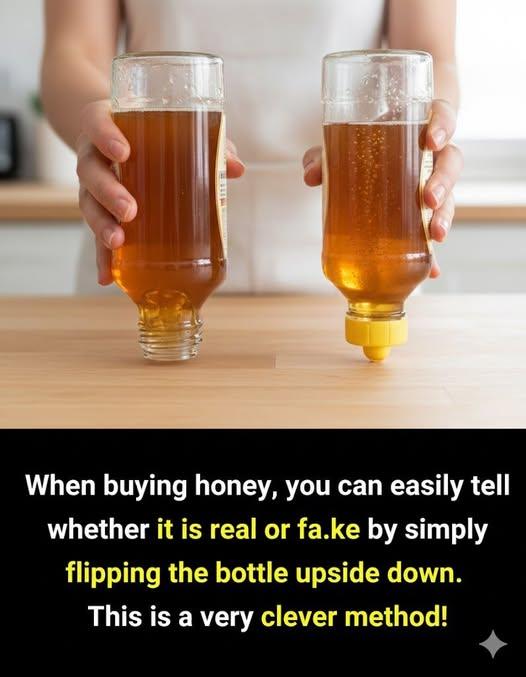
When buying natural products, it’s important to know exactly what you’re consuming. Honey is often called “liquid gold,” but its popularity means many store-bought versions aren’t pure. You may have seen videos online claiming there’s a quick way to tell the difference just by flipping the bottle.
The “Bottle Flip” Method
A common tip circulating on social media says: “Turn the honey bottle upside down—if it moves slowly or barely flows, it’s real. If it runs fast like water, it’s fake.”
It seems like a clever trick, but while there’s some truth in the idea, it isn’t foolproof.
What the Flip Test Suggests
- Real honey: Pure honey is thick, so a bubble rises slowly when the jar is inverted.
- Fake honey: Diluted with sugar syrup or water, it flows quickly.
Why the Flip Test Can Be Misleading
- Temperature affects thickness – Warm honey thins; cold honey thickens. A pure jar can appear runny in a warm kitchen.
- Processing changes texture – Pasteurized or filtered honey is often thinner than raw honey, even if it’s 100% real.
- Some fake honey is thick too – Modern adulterated honey can mimic the slow flow of real honey.
- Bottle shape matters – Narrow or wide openings change how fast honey moves, regardless of purity.
More Reliable Home Tests
Thumb Test: Place a drop on your thumb. Real honey stays in place; fake honey spreads or drips.
Water Test: Drop a spoonful into water. Real honey sinks without dissolving immediately; fake honey disperses quickly.
Paper Test: Put a drop on tissue paper. Real honey won’t soak through; watered-down honey leaves a wet stain.
Tips for Buying Real Honey
- Read labels carefully: Avoid anything with “fructose,” “glucose,” “syrup,” or “honey blend.”
- Look for certifications: Seals like USDA Organic or True Source Honey indicate authenticity.
- Buy local: Local beekeepers can give you the most reliable product and answer questions about harvesting.
- LOOK NEXT PAGE
ADVERTISEMENT
